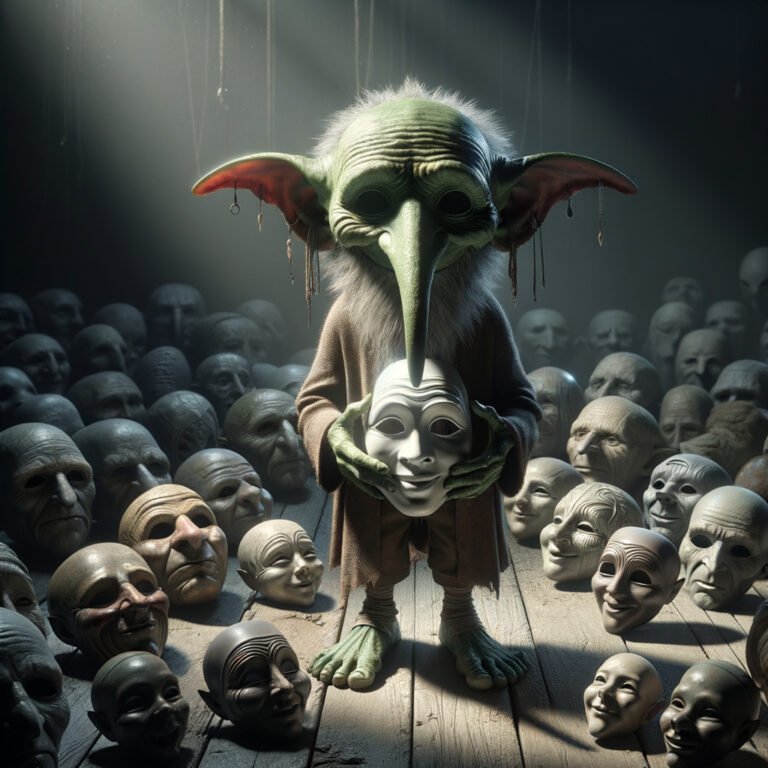
Chrysalis of Tomorrow: The Goblin With a Thousand Faces
Behold the goblin—ugly in face, fragile in form, with an ever-growing nose—the very embodiment of its grotesque character and compulsion to tell lies.
A wretched being requires a thousand masks—a thousand hollow ideologies—in which to pour its unsavory spirit.
Indeed, its emptiness is like a nesting doll—each hollow shell enclosing another, equally hollow, echoing nothing but its own ever-shrinking, nihilistic unbecoming.
Every ideology is, in truth, both an encasement of one’s character and a justification for it.
The need to justify oneself—to rationally fortify one’s will against both oneself and the world—is perhaps the most telling characteristic of the goblin’s thousand masks.
Worse than being the last resort of the weak, rational argumentation—which inherently demands self-justification—reveals the ugly core of that which must be justified in order to persist; to justify—to plead one’s case before the tribunal of reason—is to confess one’s insufficiency.
Beauty and admirability, in both character and appearance, do not argue—they conquer, subdue, and rearrange their subjects.
The goblin—tethered to rationality by necessity, yet secretly envying the strength of will possessed by nobler beings—inevitably seeks to bind the bold and beautiful to its own slavemaster: a “chain of logic” that imprisons one from expressing their finer instincts.
But alas, the eagle—in all its splendor—belongs to the skies. And while the goblin may vainly fasten waxen wings to itself, the eagle not only reaches the sun, but returns bearing heavenly fire.
A slimy perversion—a mawkish, kakistocratic will to invert what is worthy and beautiful—is shrouded in the goblin’s filthy garb of ‘the least of these.’
The goblin’s naked truth is its desire to punish with impunity, to ascend without consequence, and to punch upward while moralizing against the steady hand that dares to set it straight.
Truthfully, the will to immunize oneself against scrutiny of one’s worst aspects is indistinguishable from the will to tyranny.
Listen carefully for it—the tyrant’s quiet admission of their will to tyrannize, their declaration that they are “beneath” all criticism and must be safeguarded from it.
They always confess their tyranny when under the knife—and when jabbed, it is their most cancerous tumors that screech the loudest, desperate to preserve their spreading decadence.
As one’s scalpel caresses its subject, pay close attention to the parts that tremble most in anticipation of the operation. And when a part reveals itself as wholly resistant to transformation—do not merely jab, but twist the knife, and excise what proves incapable of a worthy becoming.